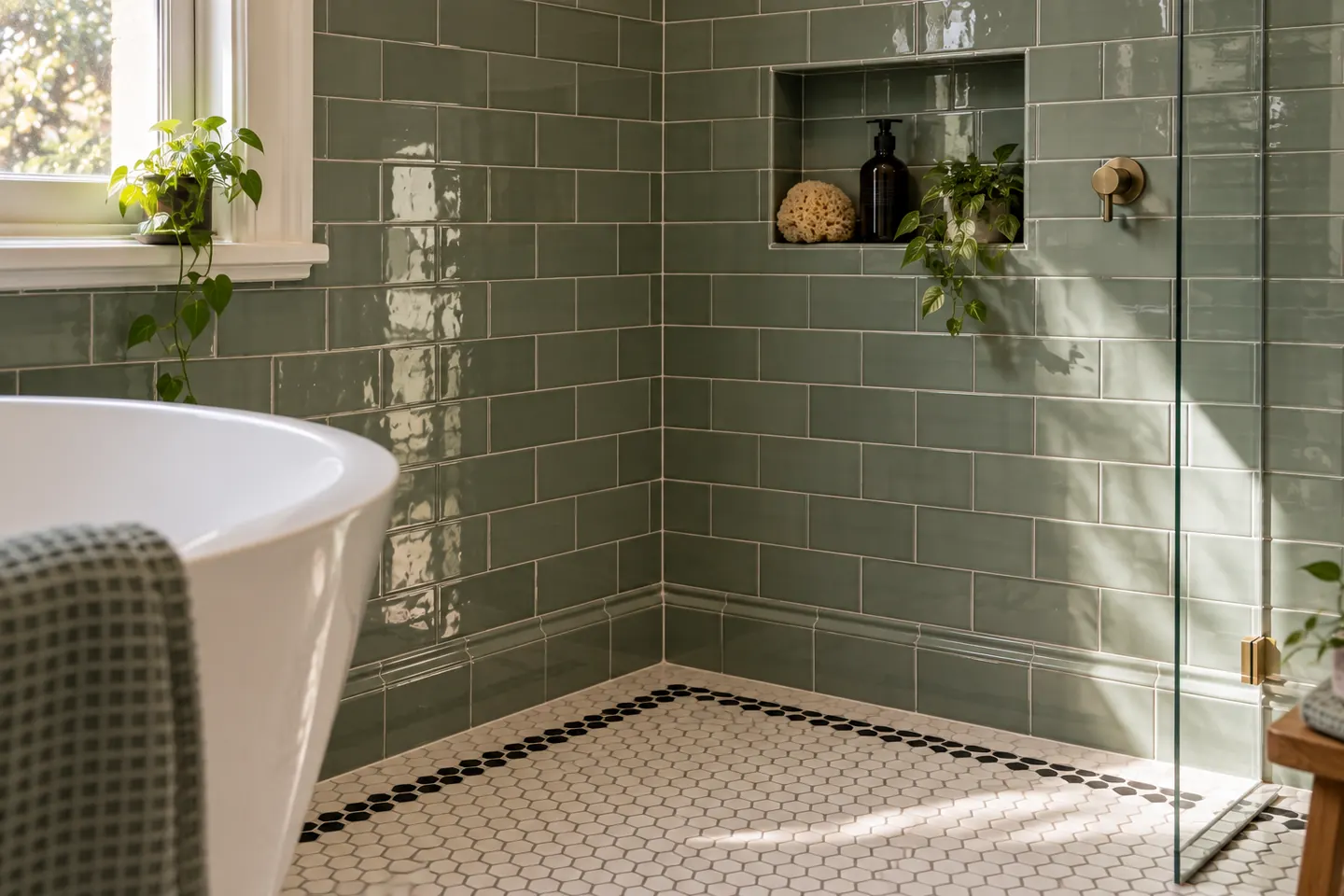
Setting out on walls that were never straight
Bricklayers in the 1890s were not working to modern tolerances, and 130 years of settling has not helped. It is normal for a terrace bathroom wall to be 15mm out of plumb over its height, and for a room to be several millimetres wider at one end than the other.
A good tiler deals with that before the first tile goes on:
- Flattening the substrate with render or a stud lining so the tile face is flat, even if the brick behind it is not
- Finding the centre lines of the room and the most visible wall, and starting there so cuts are even at both ends
- Hiding the taper at the least visible junction — behind the door, in the shower corner, or under a vanity
- Keeping horizontal lines level to the eye rather than parallel to a sloping ceiling or floor
Patterns such as subway and hexagon show errors quickly, which is why set-out matters more with period-style tiles than with large plain ones.
Floor tiles that suit old houses
Encaustic-look porcelain. The patterned tiles found in Victorian hallways, reproduced in porcelain so they are durable and do not need sealing like real cement tiles. A strong choice for a small bathroom floor, often with plain walls.
Hexagons and small mosaics. Classic for Federation-era bathrooms. Mosaics on sheets follow a falling floor well, which helps in showers without a hob.
Terrazzo-look. Suits houses that were renovated in the mid-century and some 1960s units.
Large-format porcelain. Fewer grout lines and faster to lay, but less forgiving on a floor that is not flat. On a timber floor, flatness and stiffness have to be sorted first.
Slip resistance matters on any bathroom floor. Ask for the slip rating to be stated for floor tiles, especially inside the shower.
Wall tiles
- Subway tiles in gloss white or a soft colour, laid in a straight brick bond or stacked vertically to make a low room feel taller
- Handmade-look or zellige-style tiles with a slightly irregular glaze that forgives an old wall
- Large plain porcelain where a quieter background lets the floor or the vanity do the talking
- A picture rail or border tile at a set height where the walls change from one tile to another
Details that separate good tiling from average
Falls. Water must run to the waste without ponding. In a shower without a hob, the fall is built into the screed, and the tile layout follows it.
Movement joints. Internal corners and the floor-to-wall junction are sealed with flexible sealant, not grout. Timber-floored houses move more than slab homes and grout in those joints cracks within months.
Niches. A recessed shower niche is easiest in a stud wall. In a double-brick party wall, a niche means cutting into a shared wall, so a niche on a stud or false wall is the better choice.
Trims and edges. Mitred corners look best but take longer. Metal trims are quicker and more durable in high-traffic spots.
Grout colour. A mid-grey grout hides staining better than bright white on a floor, and still reads light.
Tiling over the membrane
Tiles only go down once the waterproofing has cured and been inspected. The adhesive must be compatible with the membrane. Rushing that step to save a day is how new bathrooms leak.
What drives the tiling cost
As a rough 2026 guide, supply is anything from about $40 to well over $150 per square metre depending on the tile, and laying a straightforward large tile costs less per square metre than hexagons, mosaics, herringbone or small subway. A typical Inner West bathroom has 25 to 40 square metres of tiling when the walls go to the ceiling.
The cost page shows how tiling fits into the overall bathroom bands.
Choosing and ordering
Choose tiles before demolition, not during. Order about 10 per cent extra for cuts and breakage, more for patterned floors where matching matters. Keep a box of spares — a replacement tile from the same batch in five years is hard to find.
Renovation work is carried out in partnership with Coastal Renovation Group, a licensed NSW builder; licence and insurance details are provided on request. The deposit on residential building work in NSW is capped at 10 per cent, and for work over $20,000 home building compensation cover must be in place before a deposit is requested.
For the room around the tiles, see full bathroom renovations. Call 02 5950 5195 or send the room details through.
Questions people ask before they commit
What tiles suit a Victorian or Federation bathroom?
Patterned or encaustic-look porcelain floors, small hexagons, gloss or handmade-look subway tiles on walls, and a simple skirting or border tile. None of it has to be reproduction; a modern porcelain in a period format sits comfortably in an old house.
Can tiles go straight onto old brick walls?
Rarely well. Old brick is uneven and may hold moisture. Walls are usually rendered flat or lined with a stud wall and wet-area board first, then membraned in the wet zones. That is what gives the tiler a flat, stable surface.
Why do some tile choices cost more to lay?
Labour. Hexagons, mosaics, herringbone, small subway tiles and mitred corners all take longer per square metre than a large tile on a straight lay. The tile price is often the smaller part of the difference.
Should tiles go to the ceiling?
In most Inner West bathrooms, yes. Rooms here are small, ceilings in lean-tos can be low and sloping, and a painted strip above tiles tends to mark and peel with condensation. Full height is easier to clean and looks more finished.