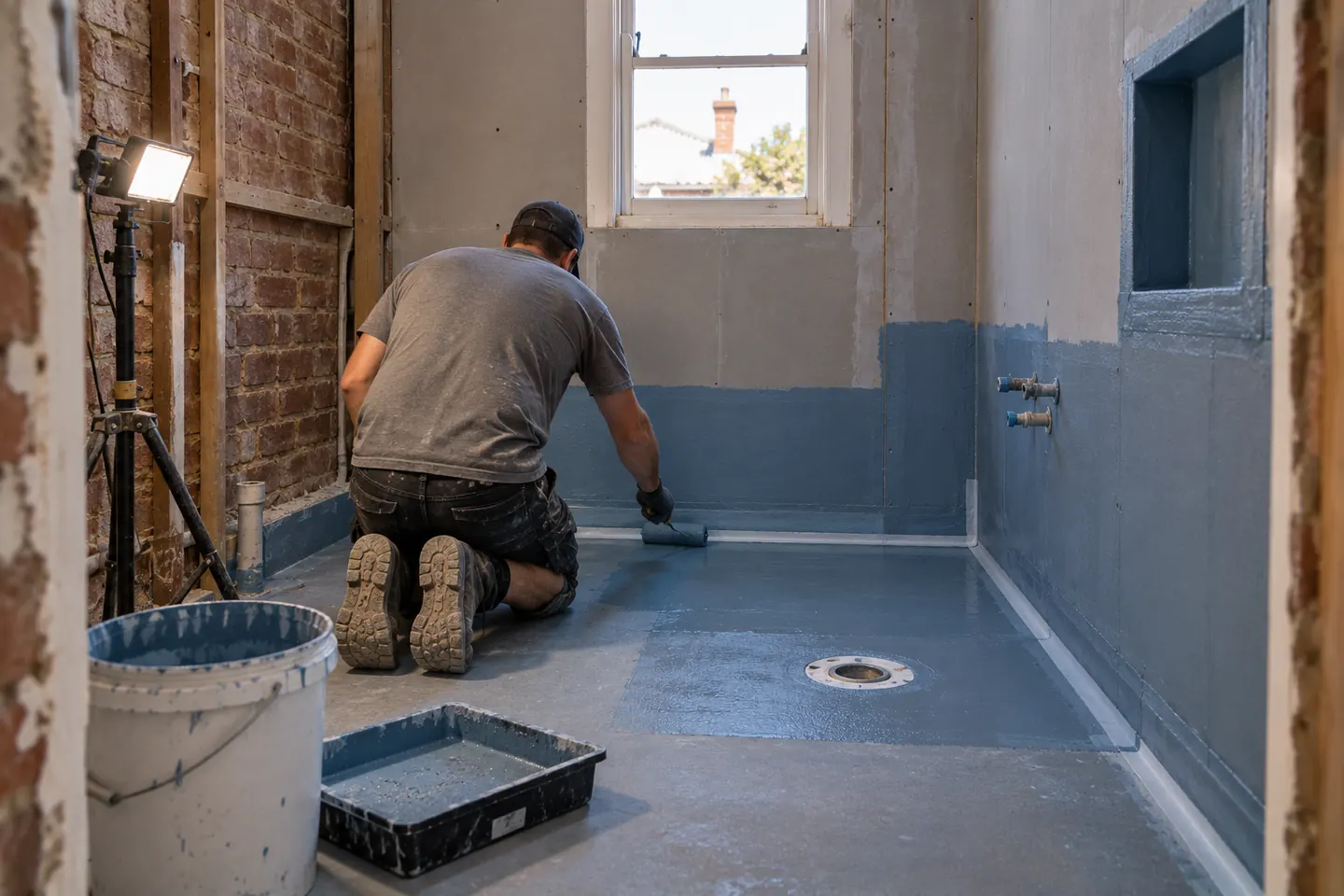
Why old bathrooms leak
The Inner West has plenty of bathrooms that were renovated before waterproofing was treated as a separate trade. It was common to fix fibro or plasterboard to studs, tile over it, and rely on grout to keep water out. Grout is porous. Given enough showers, water gets through.
Where it goes next depends on the house:
- In a lean-to on timber, into the bearers and joists, which rot slowly and quietly until the floor goes soft
- Against a brick party wall, into the masonry, where it shows up as flaking paint or salt on your neighbour's side
- Upstairs, into the ceiling below, as a brown ring that grows every winter
- In a unit, down into the unit below, which turns a bathroom problem into a strata dispute
What gets waterproofed
Under the current Australian Standard for wet-area waterproofing, the shower area floor and walls, the bathroom floor, and areas around baths and tubs all have defined requirements. In practice, a renovated bathroom here gets:
- The whole floor membraned, not only the shower
- Shower walls membraned to at least the required height, and higher in most of our jobs
- Bond breakers and reinforcing at wall-to-floor and wall-to-wall junctions
- Puddle flanges at each floor waste, so water on top of the membrane can still drain
- A water stop at the doorway, so a flooded floor does not reach the hall carpet
- Treatment around every pipe penetration
Substrates in old houses
Timber floors. The floor structure is checked, stiffened where it bounces, and the old boards or sheeting replaced with a wet-area-rated product. A screed may be laid to form the fall to the waste. Movement joints are detailed so the membrane is not torn when the house moves in summer.
Brick walls. Old brick is uneven and may be damp. Walls are typically either rendered flat or lined with a stud wall and wet-area board. A stud lining has a bonus in a terrace: pipes run inside it instead of being chased into a party wall.
Concrete slabs. Common in units and some 1950s–60s additions. Old tiles and bedding are removed, the slab is checked for cracks and ponding, and the membrane goes on a clean, primed surface. In a strata building the slab is common property, so any cutting or grinding is covered by the approval.
Upstairs showers
An upstairs ensuite in a terrace sits over rooms you care about. A few extras are worth insisting on:
- A shower area that is recessed or built up so there is no reliance on a hob
- A linear or square waste with a flange designed for use with a membrane
- Membrane lapped well up the walls around the whole room, not just the shower
- A visual inspection of the membrane before any tile goes on, with photographs you keep
See ensuite renovations for how the floor itself is prepared.
Damp that is not a leak
Some Inner West bathrooms are wet for other reasons. Rising damp in old brick without an effective damp-proof course. Condensation from a fan venting into the roof space, or no fan at all. A lean-to roof leaking at the flashing where it meets the main wall.
A membrane will not fix any of those. They are diagnosed at the measure, because tiling over a damp wall only moves the problem.
Ventilation is part of waterproofing
Moisture in the air ends up in the walls and ceiling. A properly sized exhaust fan, ducted to outside, running on a timer after the shower is turned off, is one of the cheapest items in a renovation and one of the most effective. It is included in every bathroom we price.
Cost and certificates
Waterproofing is usually priced within a full renovation rather than separately. As a rough guide, the membrane and preparation for a typical bathroom is a few thousand dollars of the total — more on a timber floor that needs new sheeting, less on a sound slab. It is the last place to economise.
You receive a certificate at completion. Keep it.
Licensing and payment
Waterproofing is part of residential building work. Renovation work arranged through this site is carried out in partnership with Coastal Renovation Group, a licensed NSW builder; licence and insurance details are provided on request. The deposit on residential building work in NSW is capped at 10 per cent, and for work over $20,000 home building compensation cover must be in place before a deposit is requested.
For the finish that goes over the membrane, see bathroom tiling. Call 02 5950 5195 or send the room details through.
Questions people ask before they commit
Can a leaking shower be fixed without a full renovation?
Sometimes, if the leak is at failed grout or silicone rather than the membrane. Regrouting and resealing can buy years. If water has already got behind the tiles, into the floor frame or through a party wall, a proper fix means removing the tiles and installing a membrane.
Is waterproofing different on a timber floor?
Yes. Timber moves with moisture and temperature, so the floor is stiffened and sheeted with a suitable wet-area board, joints and corners are reinforced, and a membrane that tolerates some movement is used. On an upper floor this matters even more, because a failure lands in the ceiling below.
Do I get a certificate?
Yes. The waterproofer provides a certificate once the membrane is installed and inspected. Keep it with the house records; a buyer, a strata manager or an insurer may ask for it.
How long does a membrane need before tiling?
It depends on the product and conditions. Most liquid membranes go on in more than one coat with drying time between, and cold, damp Inner West winters can stretch that. The program should show the cure as its own line.