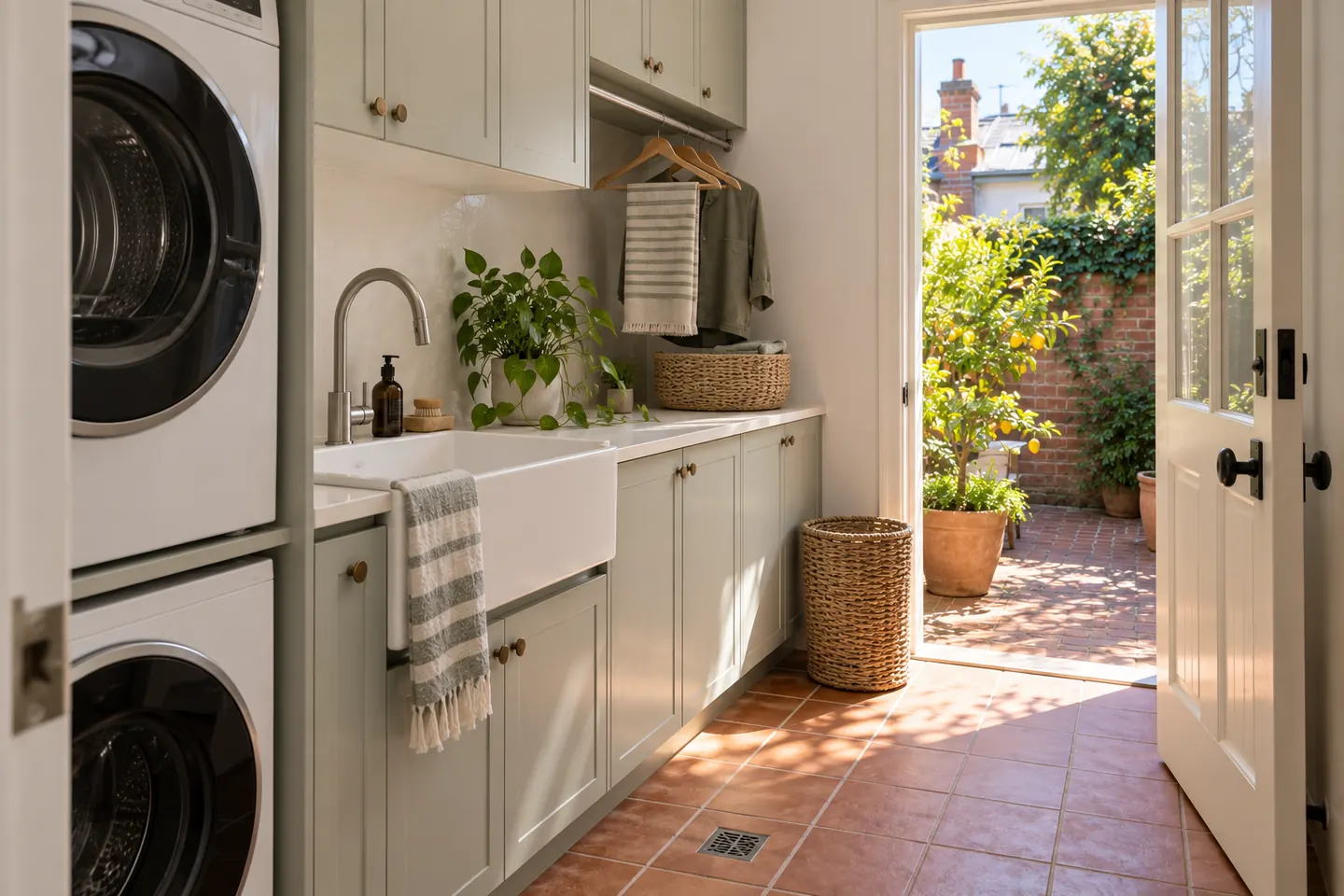
Where Inner West laundries live
Walk to the back of most Victorian and Federation houses here and you find the laundry in one of a few spots:
- The last room of the rear wing, past the kitchen and the bathroom, often with a step down, a concrete floor and a door to the yard
- Inside the lean-to bathroom, with the tub beside the shower and the machine wedged under a bench
- An outbuilding in the yard, the descendant of the original wash-house
- A cupboard in a renovated house or a unit
Each has a different renovation answer.
The rear-wing laundry
This is usually the biggest laundry in the house and the worst used. The fixes are simple: a bench with the machine and dryer underneath or stacked in a tall cabinet, a proper tub set into the bench, overhead cupboards to the ceiling, a hanging rail for shirts, and a floor that is sealed and drains.
Two local issues come up often. First, rising damp at the base of the brick walls, which paint cannot hide for long; it needs to be addressed before new cabinetry is fixed to the wall. Second, the step down to the laundry, which is sometimes worth removing when the floor is being redone anyway.
Folding the laundry into the bathroom
In a narrow terrace, giving up the rear room entirely can make sense. The washer and dryer go into a tall cabinet in the bathroom, or under a bench behind bifold doors, and the rear room becomes a pantry, a study nook or part of the kitchen.
This works best when the bathroom is being renovated at the same time, because the plumbing, waterproofing and tiling trades are already there. Done separately a few years apart, you pay for the set-up twice. See full bathroom renovations.
What it needs:
- A cold and hot supply and a waste for the machine
- A dedicated power point in a position that meets electrical rules for wet areas
- Ventilation for the dryer, or a heat-pump dryer that does not vent moist air
- A floor waste and membrane under the machine position
The cupboard laundry
In walk-up units and in houses where every square metre is spoken for, a cupboard laundry is often the whole brief. A stacked washer and dryer, a narrow tub or a sink set into a short bench, and doors that close it all away.
In a strata building, moving or adding a laundry needs owners corporation approval in the same way a bathroom does, because it involves plumbing and waterproofing.
The outside wash-house
Some cottages in Marrickville, Leichhardt and Rozelle still have a brick wash-house in the yard. Converting it back into a usable laundry is possible, but the drainage, the roof and the walls are often in poor shape. It is also worth asking whether the yard space is worth more than the laundry, particularly on a small lot.
Materials that last
Laundries take knocks and humidity. Cabinet carcasses in moisture-resistant board, laminate or compact laminate benchtops, a stainless or composite tub, porcelain floor tiles with a slip rating suitable for a wet floor, and a sealed grout. If a stone look is wanted for the benchtop, remember that engineered stone has been banned in Australia since 1 July 2024; porcelain and laminate are the usual choices.
What it costs and how long it takes
As a guide for 2026:
| Laundry type | Typical range |
|---|---|
| Cupboard laundry | $8,000 – $15,000 |
| Rear-wing laundry, full renovation | $12,000 – $25,000 |
| Laundry combined into a bathroom renovation | adds about $6,000 – $12,000 to the bathroom |
A standalone laundry is usually one to two weeks on site. Asbestos removal, damp treatment or a new floor add time. The cost page has the bathroom bands for comparison.
Before you start
Test for asbestos in any pre-1990 laundry. Decide whether the laundry stays, moves or shrinks before designing the bathroom. Ask for the cabinet materials to be named. The deposit on residential building work in NSW is capped at 10 per cent, and for work over $20,000 home building compensation cover must be in place before a deposit is requested.
Renovation work is carried out in partnership with Coastal Renovation Group, a licensed NSW builder. Licence and insurance details are provided on request.
Call 02 5950 5195 or send the room details through.
Questions people ask before they commit
How much does a laundry renovation cost in the Inner West?
As a 2026 guide, a standalone laundry with new cabinetry, benchtop, tub, tiling and a floor waste runs about $12,000 to $25,000. A European-style cupboard laundry is often $8,000 to $15,000. Doing the laundry at the same time as the bathroom usually costs less than doing it separately later.
Can the laundry move into the bathroom or a cupboard?
Often, yes. Moving it frees the rear room for a pantry, a powder room or simply a wider kitchen. The washing machine needs a waste, water supply and power; a floor waste and waterproofing are strongly advisable wherever a machine sits.
Does a laundry need waterproofing?
Laundries are wet areas and the relevant standard sets waterproofing requirements, particularly around the tub and at the floor where there is a floor waste. On a timber floor or upstairs, a full floor membrane is the sensible choice.
Is there asbestos in old laundries?
Laundries in pre-1990 Inner West houses are a common place to find fibro walls, old sheet flooring and asbestos-cement eaves outside the door. Testing before demolition is standard practice.